
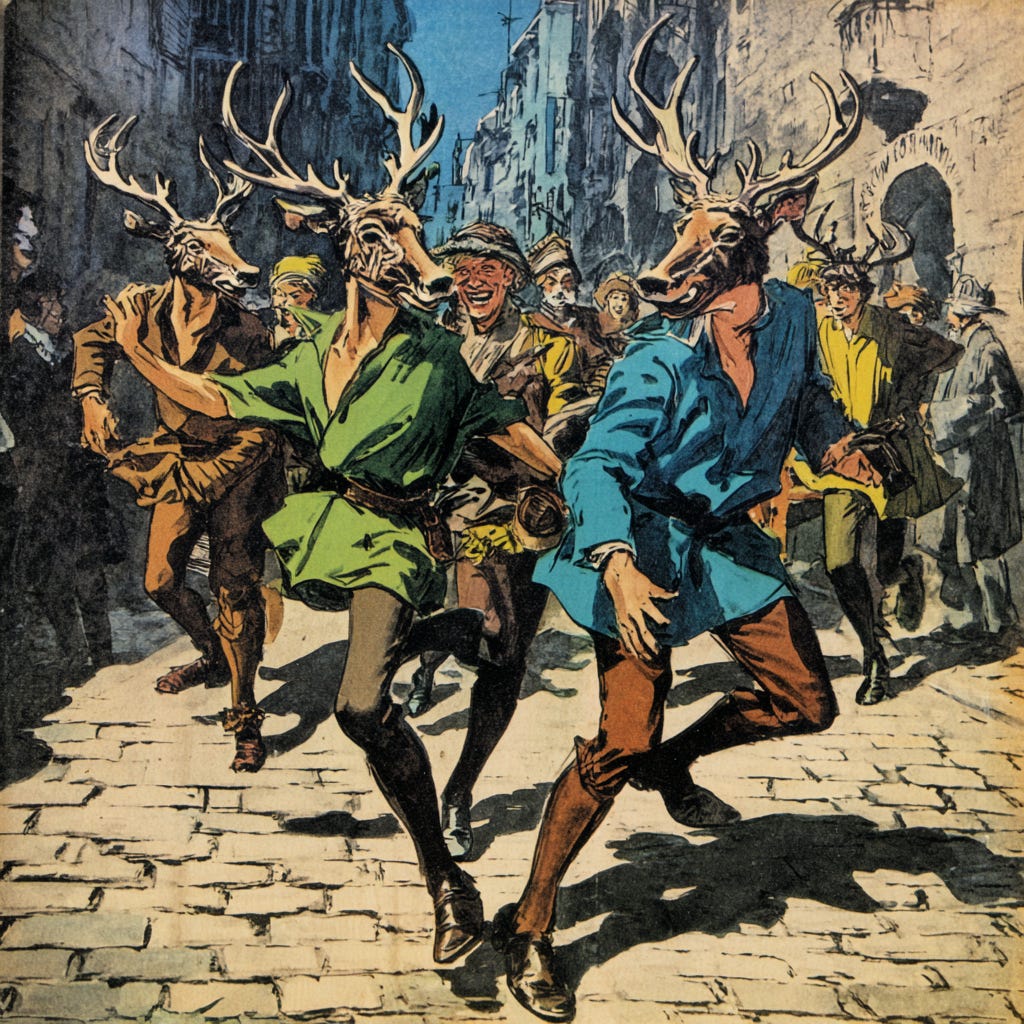
Picture this: It’s January 1st in Arles, early 6th century. The streets are complete chaos. Men stumble through cobblestones wearing women’s dresses and flower crowns. Others have donned stag heads and goatskins, bleating mock-prayers to Janus. Wine flows from jugs held by baptized Christians who were literally in church last Sunday. Dice clatter. Fortune-tellers whisper predictions. The whole city has shut down for the Kalends of January, the way it’s shut down for this week since before anyone can remember.
Inside the basilica, Bishop Caesarius of Arles is seething.
He’s been preaching against this for years. Every January he rails against the “devilish activities”, dropping multi-hour kino sermons diagnosing the “diabolical jouissance” of it all: the gender-bending drag, the zoomorphic fetish gear, the Dionysian blackout sessions.
“How is it,” he thunders to his half-empty church (everyone else is at the party), “that an intelligent man, a Christian, is not ashamed to do on the Kalends of January what a pagan would blush to do?”
Outside: primal whoops, percussive frenzy, collective hysterical laughter ricocheting off the Roman stonework.
Caesarius deploys every tool in the ecclesiastical arsenal: interminable homilies, anathemas, excommunication speedruns. He even mandates January 1–3 as obligatory fasting and mortification days. Nothing works.
Here’s what he knows in his bones: he’s losing. This party has been happening for 700 years. The Church has been fighting it for maybe 200. The math is not in his favor.
Smash cut to Times Square, 2026, tourists packed like sardines in ugly LED glasses, awaiting the descent of the neoliberal spectacle-ball sponsored by whatever soulless megacorp paid for the naming rights this year. 10…9…8… confetti blast, compulsory hetero makeouts with strangers who smell like vodka and regret, immediately posting your delusional “glow-up arc” resolutions that you’ll abandon faster than a tradcath wife abandons Vatican II the moment she gets a whiff of 1950s aesthetics.
The party never stopped. Caesarius lost.
Here are the facts: January 1st has exactly zero Christian significance. Jesus wasn’t born, didn’t die, didn’t rise on this date. The Annunciation? Nope. Pentecost? Try again. The eighth day after Christmas when baby Jesus gets circumcised? Correct. That’s the profound cosmic significance of the date we’ve designated as the moment of renewal and fresh starts. That’s your “cosmic renewal” moment, goyim: a tiny bris for the Messiah.
The Church knew this. Church fathers condemned January 1st for centuries. They tried alternatives. March 25th (the Annunciation), Easter, December 25th, September 1st. England used March 25th for seven hundred years. These were serious, sustained attempts to have a theologically meaningful calendar.
They all failed. We’re still celebrating on the Roman date. The pagan date. The date Caesarius called devilish.
How did that happen?
Let’s establish the hegemonic narrative around what we think we’re celebrating. New year, new you. Fresh starts. Renewal and rebirth. The turning of the cosmic wheel. Entire industries are parasitic on this cope. Gym memberships, diet plans, vision boards, dry January discourse. We’ve collectively decided this particular midnight means something cosmically, spiritually, personally significant.
But January 1st is arguably the worst possible date for symbolizing renewal. The dead of winter. Nothing is being born. Nothing is sprouting. It’s cold and bleak and you’re fat from Christmas and mostly trying not to die of seasonal depression.
If you wanted actual renewal symbolism, you’d pick spring when things literally renew, or the winter solstice when light actually returns.
And did I mention the church loathed that day?
The early Church fathers were absolutely unhinged about January 1st celebrations.
John Chrysostom preached entire sermons against Christians joining the “shameful practices.” Drunkenness, dancing, gambling, general debauchery. Augustine condemned the “sacrilegious rites.” But Caesarius is the MVP of anti-January 1st discourse. Multiple sermons cataloging the depravity: men cross-dressing, wearing animal skins, fortune-telling, excessive feasting. His frustration practically radiates through the Latin. Absolutely seething.
The Council of Tours in 567 CE declared January 1-3 as official days of fasting and penance. Ecclesiastical decree: no feasting, just prayer and self-denial.
Spoiler alert: it didn’t work. People kept partying. The vibes were too immaculate.
And the Church had alternatives that actually made theological sense! March 25th, the Annunciation, when God enters time and salvation history starts. England used this for 700 years. Easter, the Resurrection, literally the most important event in Christianity. December 25th, at least explicitly about Christ. September 1st, what Byzantium used because they believed it’s when God created the world.
All of these were more defensible than January 1st. All were tried by various parts of Christendom. All lost to January 1st.
Why?
Here’s where the story gets magnificently stupid in a way that
